

Midlands regulars: the Southern Red Bishop
Part three of my monthly series on the birds I see most around home. In December the reedbeds light up with puffed-up red and black males, each one building nests and showing off to win over the females.
This month in Midlands regulars: This time we’re heading down to the water for the Southern Red Bishop.
Drive past any farm dam or vlei in the Midlands at this time of year and look at the reeds. Somewhere in there, something bright red is bouncing about. Get closer and there are several: little red and black birds puffed up into balls, buzzing from reed to reed as if they own the place.
Knowing one when you see it
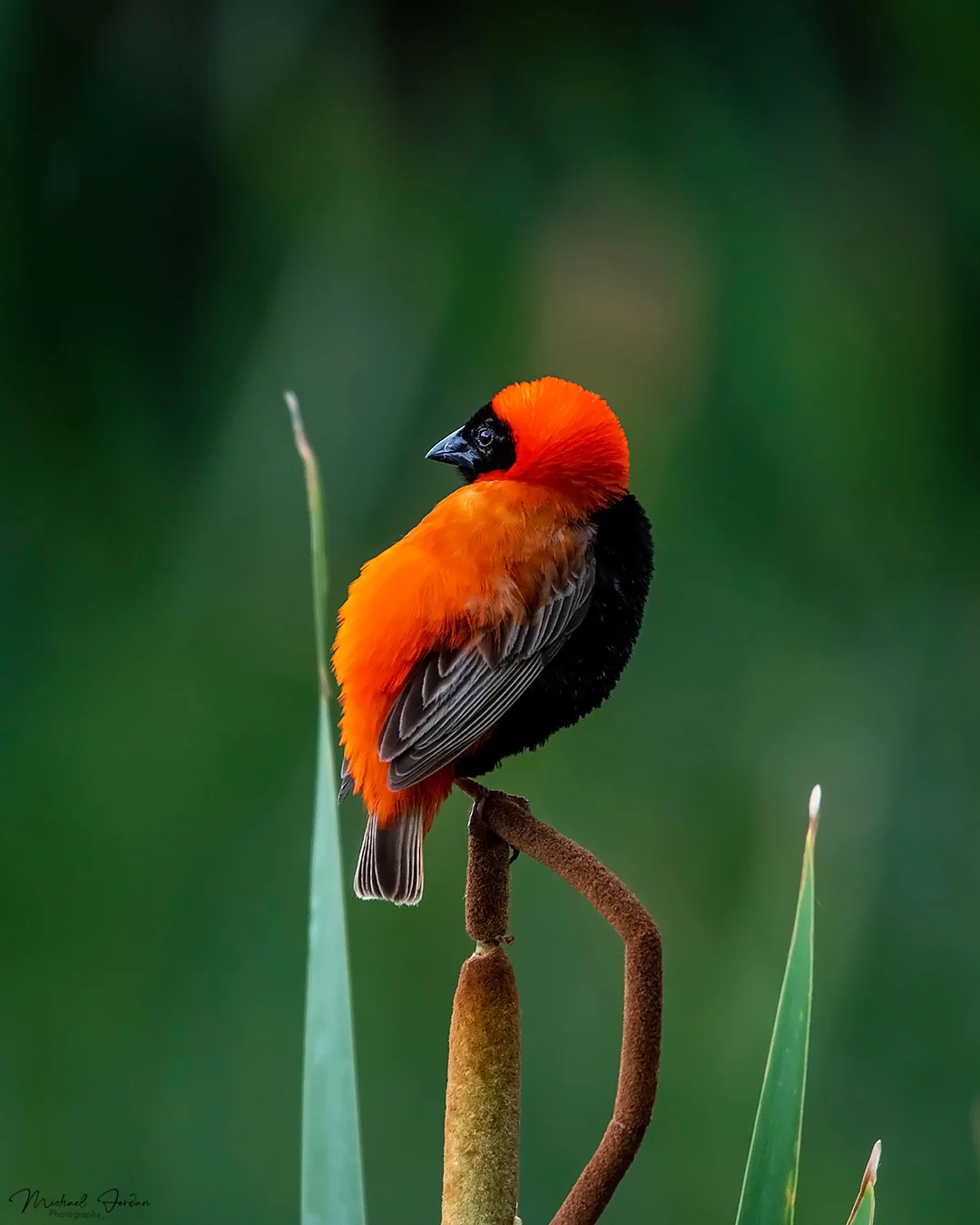
A breeding male is hard to miss. He’s small, about the size of a sparrow, with a thick, cone-shaped seed-eater’s bill. Most of him is a blazing scarlet-red, sometimes closer to orange, with a black mask across the face and a black belly. The wings and tail are plain brown, which you mostly notice when he flies.
The rest of the year is another story. Outside the breeding season the males moult into streaky brown, paler underneath, and look almost exactly like the females. Females and youngsters are small, streaky, sparrow-like brown birds with a pale, pinkish bill. They’re easy to confuse with the other bishops and widowbirds.
The busiest bird on the dam
What I love about the red bishop is that the male works for it. At the start of the season he claims a patch of reeds and starts building. Not one nest, but several: neat oval balls woven from strips of grass and reed, slung between the stems, with a little porch over a side entrance. He can knock one together in a day or two.
Then he advertises. He fluffs up every red feather until he looks twice his size, and flies a buzzing display flight over his reeds, rattling and swivelling around the stems. It’s often described as bumblebee-like, and once you’ve seen it, that’s exactly it. A female comes in, inspects the nests, and if one’s up to standard, he’s in luck.
And he’s rarely in luck just once. Red bishops are polygynous: one male can have several females nesting in his territory at the same time, and according to the Animal Demography Unit, as many as 18 over a single season. Once she’s sitting on eggs, the female won’t let him near the nest, and he plays no part in raising the chicks. He’s off showing off to the next one.
Where and when to find them
Here in the Midlands, think water. They breed in reedbeds, sedges and bulrushes around farm dams, vleis, rivers and wet patches in the grassland, often in colonies that can run to hundreds of nests. In summer-rainfall areas like ours the breeding season runs through roughly late spring to the end of summer, so December, in the middle of the rains, is about as good as it gets. The reeds are tall, the males are in full colour, and the colonies are at their noisiest.
In winter the flocks move out into drier grassland and farmland, often mixed with other weavers, and you’d walk straight past them.
Seeds, bugs and dragonflies
They’re mostly seed-eaters, picking seeds off grass heads and from the ground. In summer they take more insects, and the chicks are raised mainly on them. They’ve even been recorded catching dragonflies in the air, which is not what you’d expect from a bill built for cracking seeds.
The two from the reeds
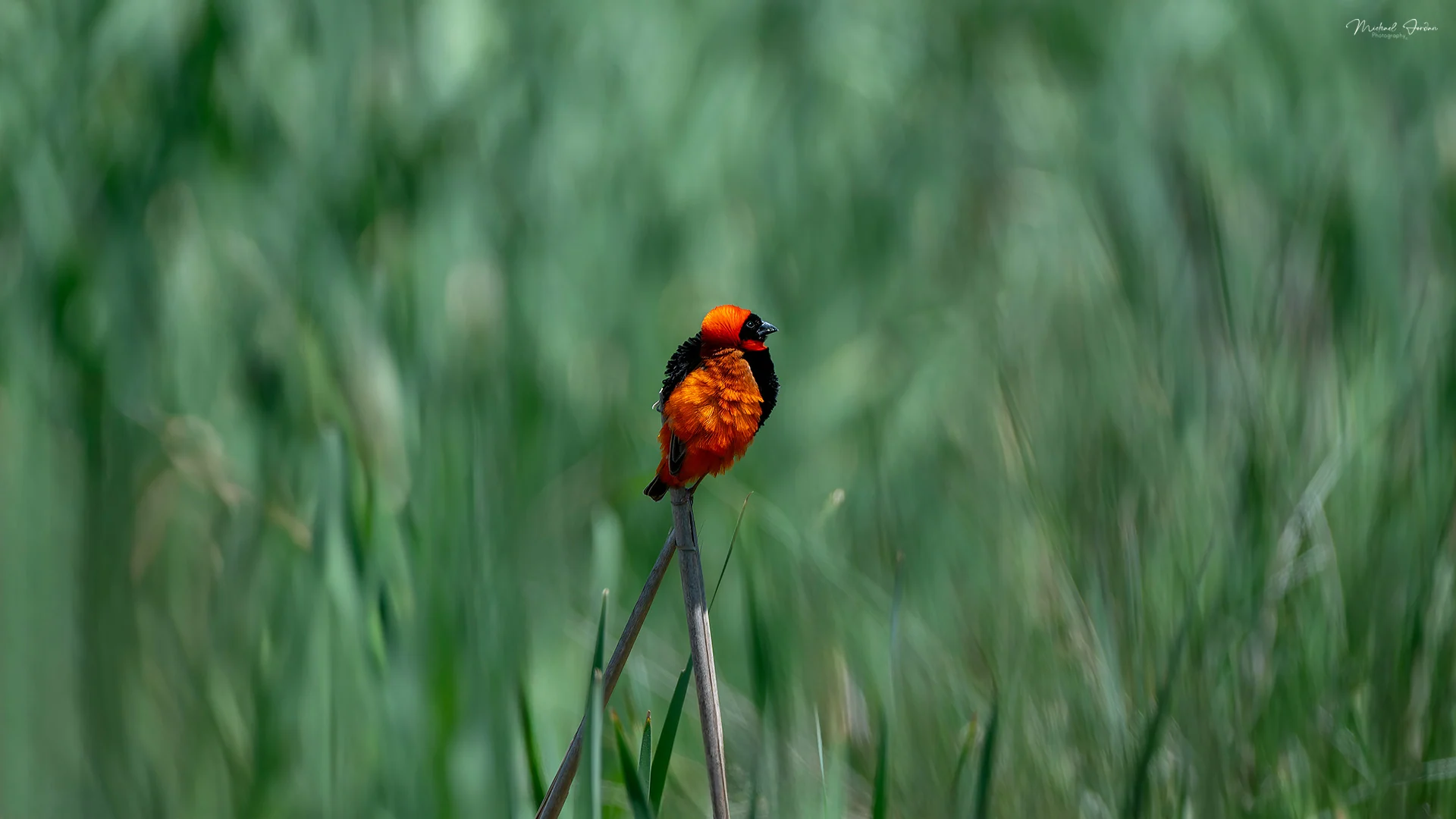
For a bird that spends half the year glowing red and shouting at everyone, they’re surprisingly hard to get a clean shot of. There’s always a reed in front of the face. These are the two I’m happiest with.
Starting with the one at the top taken at Umbogavango Nature Reserve in Amanzimtoti with a Nikon D500, on a Nikon 200–400mm f/4 at 400mm, 1/320s, F/8, ISO 1600 - this was taken while sitting in the hide over looking one of the small dams and just to the right was a nice reedbed where all of the Bishops and Weavers were nesting. This gentleman decided to come up to the top of the reed and pose for a nice shot.
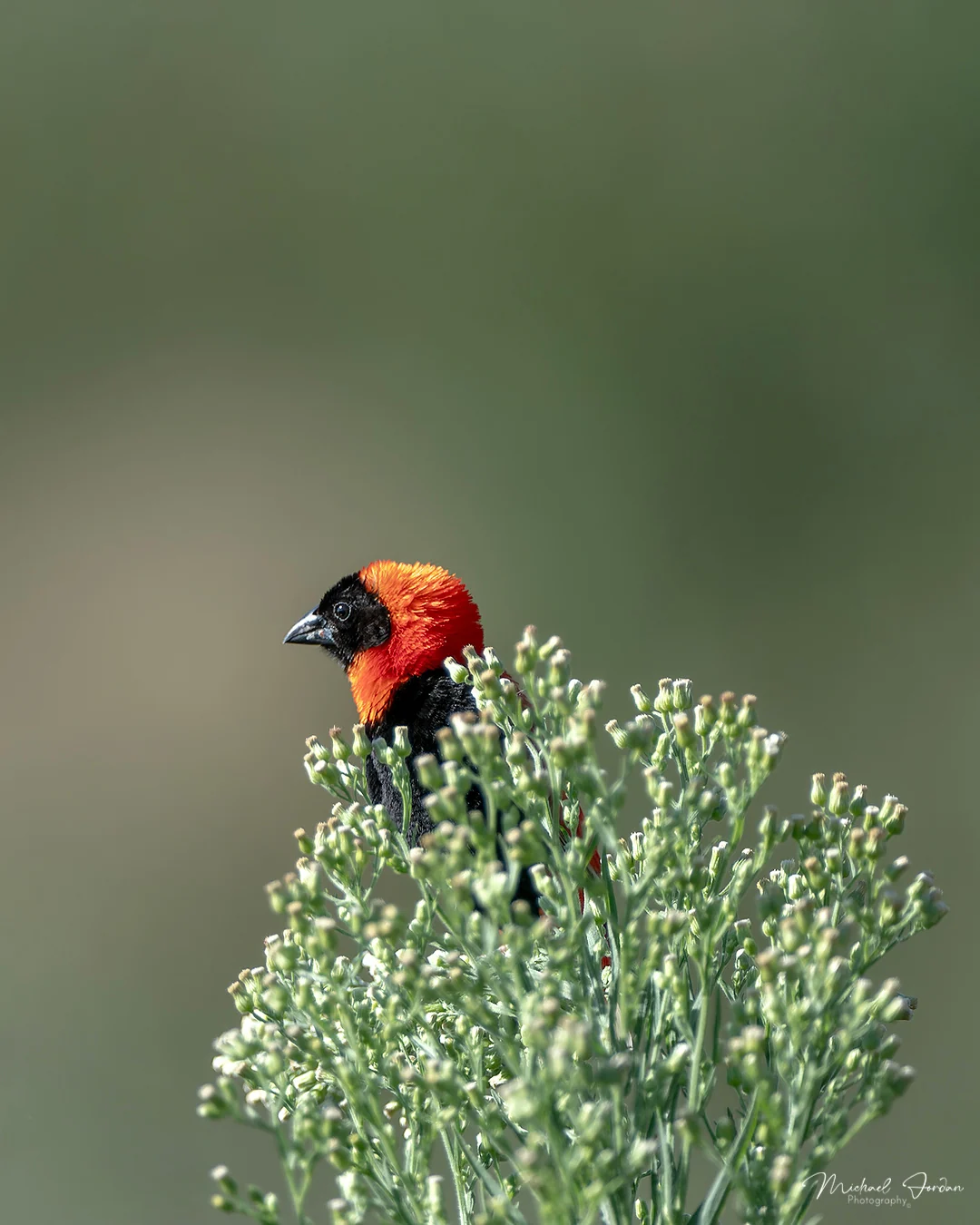
The second photo above was taken in the Kamberg Valley on Nikon D500 paired with my 200–400mm f/4 at 400mm, 1/2500s, F/4, ISO 320. I just missed this gent as he took off from the reedbeds and landed ontop of this alien weed which I believe is fleabane. I was just too slow to get the my bucket list shot for this bird.
My bucket list shot I am still chasing is a male mid-display, fully puffed up in flight. They fly like a bright read bumblebee so they are not the easiest to capture at all, but that is the fun part of it, it is a struggle which makes the fight to get it even more exciting.
Photographing them
A few things that have worked for me:
- Learn his circuit. Each male keeps coming back to the same few perches. Watch for ten minutes, then set up on his favourite stem instead of chasing him around the dam.
- Look for gaps. Reeds are the enemy of autofocus. Use a single focus point, and pick a spot where there’s a clear line between you and the perch.
- Shoot the display, not the bird. The puffed-up flight is the shot. Fast shutter (1/2500s or quicker), continuous focus, and start the burst when he fluffs up on the perch.
- Mind the red. That scarlet clips easily in hard light. Early or late light is kinder; check the red channel on your histogram.
- Keep your distance from the nests. With a long lens there’s no need to push into the reeds. Shoot from the bank and let them come to you.
Next time you pass a dam
Next time you drive past a farm dam this summer, slow down and look at the reeds. Those little sparks of red are some of the hardest-working birds in the Midlands, putting on a show right on our doorstep.
Stay tuned for the next part of Midlands regulars. If there’s a local bird you’d like me to cover, let me know.